We process your personal information to measure and improve our sites and service, to assist our marketing campaigns and to provide personalized content and advertising. By clicking the button on the right, you can exercise your privacy rights. For more information see our privacy notice.
Privacy Policy
Do you have en extra thick book of pages that you need to bind together, but you're having trouble finding something professional? Or maybe it would just be way too much work to have to punch the pages in stacks of 15 over and over again until you get your entire stack complete. Whatever you reason for needing to bind together such a large stack of paper, these 4 easy methods can help you accomplish your goal. They are simple to do, don't require any specialty bindery machinery, and can be done pretty quickly. Plus, the finished bound book is professional, presentable, and functional.
Method 1: Binding Rings
Loose leaf book binding rings are incredibly simple, inexpensive, and quick to bind. They will work great if you are using already pre-punched 3-hole paper, or even 2-hole top bind paper. But you can actually also do the punching yourself in whatever configuration you want; because the rings are loose, you can space them as close or as far apart from each other as you would like for your preference. You can do this using a hole puncher or a paper drill, which is ideal for thick stacks of paper.
Binder rings come in several styles as well, so you can choose a look that fits well with your needs. Different styles allow for different thickness capacities, so you will want to check the capacities before you settle on a look as well (check the chart below). One thing to consider when it comes to book rings is that they are round, which means that your stack won't sit square; instead, it will be offset with an inverted/rounded edge that follows the ring shape.
Method 2: Chicago Screw Posts
Screw posts are another really simple way to bind thick stacks together. They pair perfectly with pre-punched pages, such as 3-hole paper or 2-ring top-bind paper (just like the rings). And just like the rings, you can also use as few or as many as you want, with whatever spacing between each, because they are not attached to each other. This 'loose' method of binding is incredibly versatile. You can use any hole punched or paper drill for those thick stacks as well, if you don't use pre-punched pages.
Binding posts come in metal and plastic options, as well as several colors, so you can really tailor the finished look to your preference. Depending on the material they are made of, the capacities available will vary, so be sure to choose the style that will also fit your book (see the chart below). With Chicago screw posts, you might need to have creased/scored paper and a slightly larger margin. That is because the posts go straight through the stack, so when you turn pages, the post does not move or allow pages to turn all the way over. A crease can help keep pages open and make it easier to read deeper into the margin/crease.
Method 3: Ring Binders
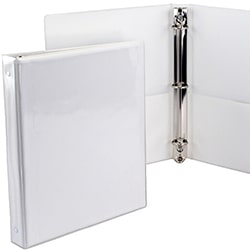
Your standard ring binder is pretty common. Basically a binder is the loose rings, but they are attached to a metal spine as well as to a cover. This wraps completely around your stack, which is convenient for protecting the pages and not needing to buy covers separately. It also makes it easier to stand up on a shelf. Ring binders are a great option for those thick stacks up paper, as the largest 4" rings can hold a very thick stack.
Ring binders come in several styles. The two most popular are a clear view vinyl, which lets you slide in custom covers to a pocket so you can essentially customize the outside look, as well as poly or plastic binders that are flexible and easy to clean. The maximum capacity does vary between the two types, so keep that in mind before you settle on a style. Ring binders make it very easy to flip through pages too, which is why they are such a classic choice. Check out the chart below to see the sizes and options available.
Method 4: Notepad Binding
Turning your thick stack of pages into a "notepad" is another option. When working with real thick stacks of pages, sometimes gluing them together is the only option. What is great about notepad binding is that there is no limit to how thick you can make the stack; since glue is manually applied to the spine, you can make it as thick or as thin as you want.
One thing to note, however, is that notepad binding uses a special padding compound glue that is meant to be torn-away, which makes it great for the tear-away notepads they are usually used for. Depending on what kind of book you are binding, though, this might not be ideal. You may also want to add extra coats of glue for thicker books to make it a bit more sturdy and strong. Glue does take time to dry, so that is another consideration before you settle.
Specification Comparison
Now we can compare the 4 methods we discussed for a bit more specific knowledge. We will show some of the different options for these methods, and compare the largest size available for each, as well as the colors to choose from. That may help you narrow down what will work best for your thick books.
About the Author • Mallory Morsa has been part
of Binding101 since 2008 and she is the primary content creator for BUY101® information. She began in customer
service and sales where she honed in her skills to provide the customer with professional, fast, and accurate
information. Shortly after, she was promoted to sales supervisor and also took on the role of product expert,
training the team on new products. Throughout this time, she also wrote content for the site, as well as contributed
stock photography and videography. As the team grew, she moved to an official position as the content specialist and
social media manager. Her skills in these variety of areas give her the unique expertise to not just create content
for the web, but to create content for you, the customer. She has a Bachelor's degree in business management and
marketing, was on the Dean's List each year, and graduated Summa Cum Laude. In her free time, Mallory's favorite
things to do include volunteering at the animal shelter by bottle feeding neonatal kittens, reading at the park,
cooking plant-based meals, playing board games, hiking, and binge streaming TV shows with her furbabies and family
beside her.
Hi! My name is Mallory and I have been in the industry since 2008. If you do the math, that is over 15 years. I have spent my time at Binding101 in many roles, including customer service, sales, e-commerce management, video production, and more! Because of this vast experience, I bring a truly expert touch to the content in our blog. widdling down complex topics to extract what our customers really want to know. As the Content and UX Manager, I act as a writer and editor for the majority of copy you will find here. When not at my computer, I love spending time binging stand-up comedy, baking, and cuddling up with my family and rescued cats and dogs...