We process your personal information to measure and improve our sites and service, to assist our marketing campaigns and to provide personalized content and advertising. By clicking the button on the right, you can exercise your privacy rights. For more information see our privacy notice.
Privacy Policy

Is an Electric or Manual Binding Machine Better?
February 13, 2019
The simple answer is that an electric machine is better. Just think about it; electric machines eliminate the need to pull a handle to punch a few pages at a time over and over until your whole book is punched, they can usually punch a higher capacity at once, they remove what some consider tedious steps, and they can increase the production speed pretty significantly.
But along with those benefits, electric machines are also more expensive...so they are not a great choice for all kinds of businesses.
If you're torn between a manual and electric binding machine --not sure whether or not the additional cost for the electric model is worth it-- then there are a few things to ask yourself before you make your investment. When you answer these questions with your operator and your business needs in mind, you should have a better idea of if an electric binding machine is worth the money, or if you should stick with a manual model instead.
1. What is your volume? Are you binding less than 20 books per month? Are your books on the thinner side, requiring only a few punched stacks per book? Is these are the case for your business, than a manual punch with manual bind will likely do just fine for your needs. If your business binds closer to 70+ books per month, or making thicker books, then have either an electric binding (especially helpful for thick coil books) or electric punching might be worth the additional investment.
2. Who will be using the machine? Whether manual or electric, these punch and bind machines are all failry simple and only require a little review of the settings to get the hang of them. If you are going to have a single user on the machine who is strong, then they may be able to handle the more manual process even for larger quantities. Whereas an older employee might prefer the convenience of electric punching. Sometimes when manually punching thicker stacks, it can be difficult to pull the handle through, so it can be labor-intensive. An electric punch eliminates that.
3. What is your Budget? Depending on the binding style (wire, coil, or comb) a manual binding machine can range anywhere from about $100 up to about $700. The range is quite significant, as the more expensive models handle larger sheet capacities and have more customization and setting options. Electric machines start at about $750 and go up to several thousands
- - - - - - - -
Now that you know the most important considerations, let's do a quick overview of the binding machine variations, because they are not always cut-and-dry manual or electric; many have a combination of both features. We discuss these differences below, as well as our most popular binding machines for each option. These machines were chosen because theyhave high customer reviews for quality, performance, and value.
Manual vs. Electric Coil Binding
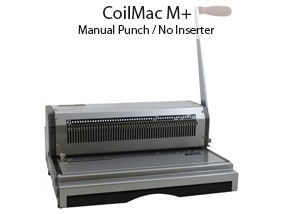
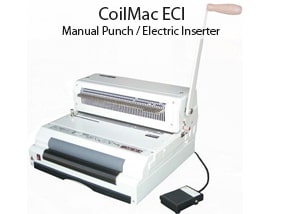
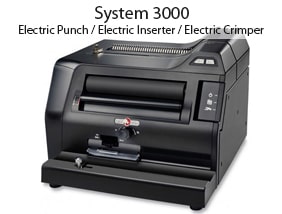
There are 5 coil binding machine combinations. 1) manual punch with no inserting rollers, 2) manual punch with electric roller inserter, 3) electric punch with no inserting rollers, 4) electric punch with electric roller inserter, 5) electric punch, electric roller inserter, and electric crimper. Because of these variations, comparing a simple manual to electric for coil binding isn't as simple as it may seem. As more electric functionality is added, the machines go up in price.
The punch on a manual coil binding machine is done with a handle. On an electric machine, it is most commonly done with a foot pedal, but some machines have a push button. The roller inserter is usually a push button that makes one of the rollers spin continuously until you push the button off again. Machines without the electric rollers require you to spin the spiral plastic coils through all of the holes by hand. A select few spiral binding machines also have electric crimper. Machines without this will need you to use a manual hand crimper or have a separate electric crimping machine.
Manual vs. Electric Wire Binding
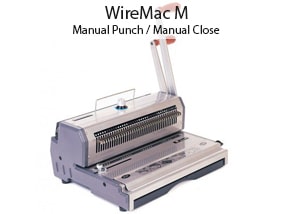
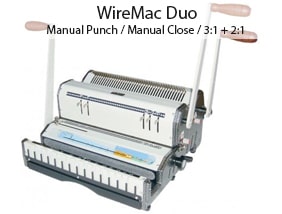
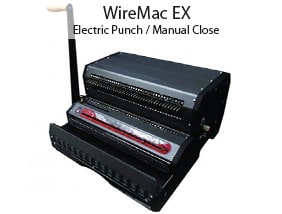
Wire binding is a bit different, as there are only 3 different wire binding machine combinations of manual and electric features. 1) manual punch with manual closer, 2) electric punch with manual closer, or 3) electric punch with electric closer. An all-manual wire binding machine will punch your pages by pulling the handle, and will close the wire spine by pulling a different handle. On the electric punch machines the action is usually done with a foot pedal, and on the rare occasion, with a button. On the all electric machines you would have a foot pedal for the punch and a button for closing.
Manual vs. Electric Comb Binding
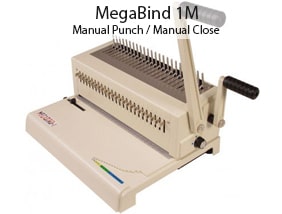
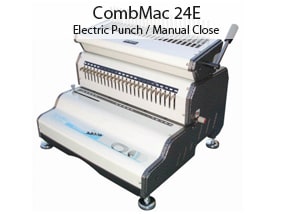
Manual and electric comb binding machines come in 2 variations. 1) manual punch, manual opener/closer, 2) electric punch with manual opener/closer. There are some modular separate electric comb opener/closers available, but the punch machines don't usually have that option. Both functions are performed with a handle when manual, or the punch with a foot pedal when electric. The plastic gbc combs are opened by pulling the handle one way, and then closed by pushing it back. Again, some smaller electric comb punches might have the push button activation instead.

- - - - - - - -
Now that you have reviewed some of the key points necessary to make the best buying decision for your business, how are you feeling about the manual vs. electric binding machine conundrum? If you still need some guidance, please call our experts at (866) 537-2244 for one-on-one care to help you decide.


Hi! My name is Mallory and I have been in the industry since 2008. If you do the math, that is over 15 years. I have spent my time at Binding101 in many roles, including customer service, sales, e-commerce management, video production, and more! Because of this vast experience, I bring a truly expert touch to the content in our blog. widdling down complex topics to extract what our customers really want to know. As the Content and UX Manager, I act as a writer and editor for the majority of copy you will find here. When not at my computer, I love spending time binging stand-up comedy, baking, and cuddling up with my family and rescued cats and dogs...
Related Products

Comment(s)


Trending Now

How to Bind Paper
January 29, 2019
What are the Best Laminators for Foiling?
July 10, 2018
How to Make a Wire Calendar 3 Different Ways
September 04, 2018
Everything you need to know about Foiling (with FAQs)
June 22, 2018
