We process your personal information to measure and improve our sites and service, to assist our marketing campaigns and to provide personalized content and advertising. By clicking the button on the right, you can exercise your privacy rights. For more information see our privacy notice.
Privacy Policy


What is involved in Hardcover Book Binding?
September 19, 2018
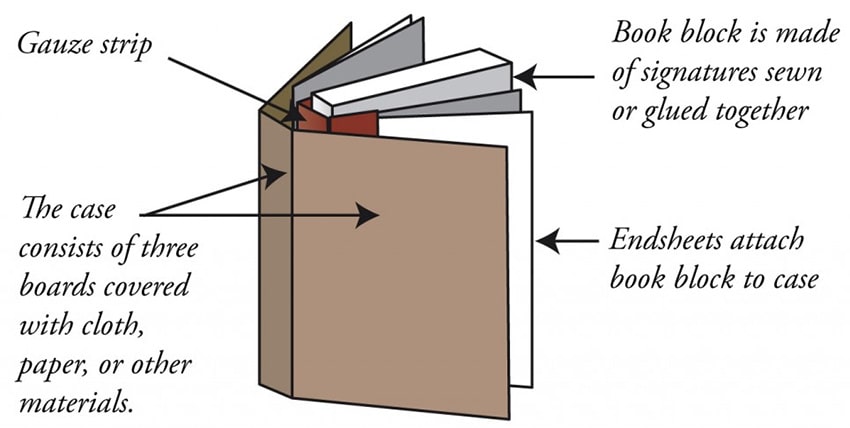
Hardcover book binding, often called casebinding or casing in, is the process of (you guessed it) binding a hard cover book. In the print and finishing industries, hard cover binding involves a specially-formulated glue that is applied to the spine of a book block (book pages) and a liner sheet (attaches to the front and back hard covers). This process involves three general steps, which usually use three different machines:
- 1. Seweing - Sewing your book block together
2. Casemaking - to make the hard cover itself
3. Hard cover binding - to bind the hard cover to your book pages
The steps involved will vary a bit depending on the machine brand and model that you are working with, but these general overviews will give you a good idea for how the processes work.
Thread Sewing - Making your Book Block
Step one for hard cover book binding is called thread sewing, and is the process where your book pages are actually sewn together with a needle and thread. Typically pages are folded together into booklets called "signatures" and then those signatures are sewn together. This can be accomplished by hand for those making their own hard cover books, or using an automated machine for print and finishing shops. After sewn together, the book blocks are trimmed to be flush.
Thread sewing is not required for all hard cover books, and is primarily used for novels. Thinner books, such as for photo book binding, will often skip this step and simply glue the signatures together.
Casemaking - Making the Hard Cover Itself
Step two for case binding is to make the case (or the hard cover) itself. To do this, you can use any number of machines, or do it by hand with some patience and skill. It involves printing your wrap-around cover page, and then adhering it to chipboards to create a hard cover. With a machine like the Casematic, lining up the 3 boards and your printed cover, and then wrapping the corners is fast and accurate.
Hard Cover Binding - Binding the Hard Cover & Book Block Together
Step three is to bind the two pieces together, finishing your hard cover book. This process involves a special binding glue that is heated up and applied to the book block spine, and then pressing the spine into your cover. Sometimes a gauze/fabric sctrip is also applied. An end sheet is also used on the first and last pages of your book to attach the book block to the covers more thoroughly, as well as hide the inside of the boards from your case.
Here at Binding101, we offer hard cover book binding machines specifically for the photobook industry (rather than publishing). This skips the sewing step, and goes straight to the case making and binding of your book block. The photo book binding process is simpler than you may imagine, though the machines can look a little intimidating to someone new to the idea. Just click here to see the photobook binding machines and supplies that we offer, and start making premium-quality photobooks for your prints shop or photography studio today.


Hi! My name is Mallory and I have been in the industry since 2008. If you do the math, that is over 15 years. I have spent my time at Binding101 in many roles, including customer service, sales, e-commerce management, video production, and more! Because of this vast experience, I bring a truly expert touch to the content in our blog. widdling down complex topics to extract what our customers really want to know. As the Content and UX Manager, I act as a writer and editor for the majority of copy you will find here. When not at my computer, I love spending time binging stand-up comedy, baking, and cuddling up with my family and rescued cats and dogs...
Related Products


Comment(s)



Trending Now

How to Bind Paper
January 29, 2019
What are the Best Laminators for Foiling?
July 10, 2018
How to Make a Wire Calendar 3 Different Ways
September 04, 2018
Everything you need to know about Foiling (with FAQs)
June 22, 2018
