We process your personal information to measure and improve our sites and service, to assist our marketing campaigns and to provide personalized content and advertising. By clicking the button on the right, you can exercise your privacy rights. For more information see our privacy notice.
Privacy Policy

How to Choose the Right Kind of Document Binding
August 20, 2018
The best document binding solution for you will vary largely on the functionality and use of your final document, as well as the size of the sheets themselves, the number of pages, and your overall budget. In this article I will go over some of the most popular ways to document bind using the traditional punch-and-bind method, highlighting these four factors for each option, so you can compare them and choose the right kind of document binding for you.
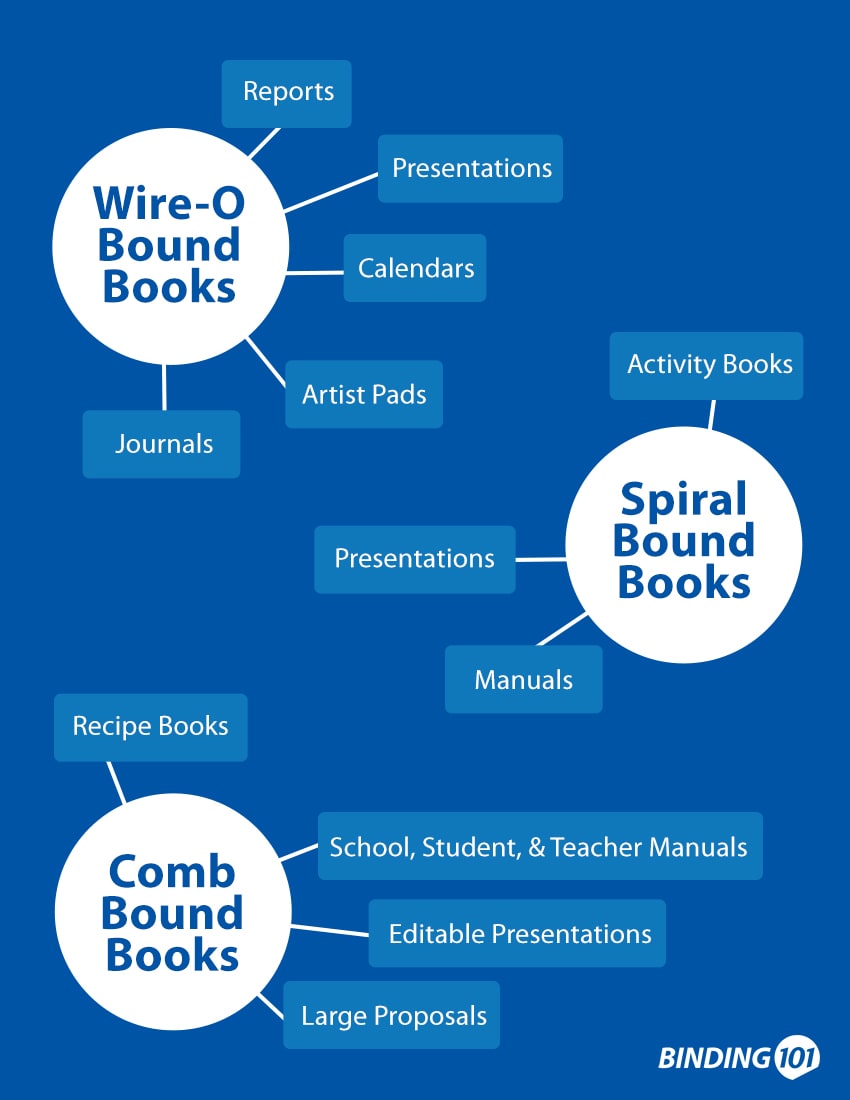
Let's start with a chart comparing the three binding methods we will discuss: Wire-O binding, spiral coil binding, and plastic comb GBC binding.
| Binding Types | Wire-O Binding | Spiral Coil Binding | Plastic Comb (GBC) Binding |
|---|---|---|---|
| Binding Types | Wire-O Binding | Spiral Coil Binding | Plastic Comb (GBC) Binding |
| Popular Uses | Journals / Notebooks Artist Pads Presentations Reports Calendars | Children's Activity Books Presentations Manuals | Large Business Proposals Recipe & Cook Books Editable Presentations Classroom Art Books |
| Sheet Sizes | Letter Size (8.5" x 11") Mini & Larger Sizes | Letter Size (8.5" x 11") Mini & Larger Sizes | Letter Size (8.5" x 11") |
| Page Capacity | 120 Pages (3:1) 260 Pages (2:1) | 440 Pages | 420 Pages |
| Budget | $$$ | $$ | $ |
Now let's discuss each of these methods in more detail, and explain why I have given the ratings above for each.
Wire-O Bound Documents
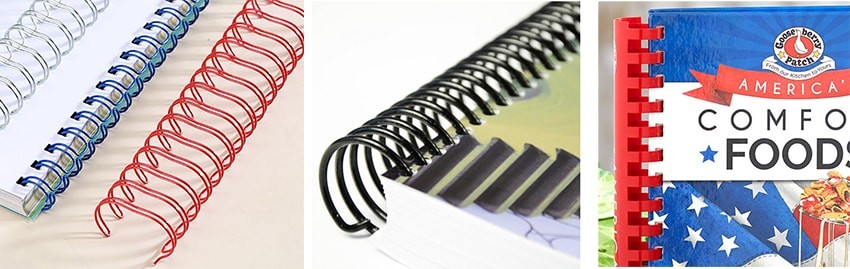
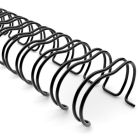
Uses: Wire-O is a punch-and-bind that is incredibly popular, primarily for the look of the finished book -- it is professional, clean, and can be made in several colors to match or compliment your printed covers or brand and logo. This makes them ideal for presentation materials, calendars, and notebooks that need to look great. The wires are looped (rather than spiraled) which means that your pages can actually flip from front to back (called 360° page turning) and have perfect registration, which keeps your pages aligned as they are turned and flipped, again, lending to the cleanliness of the finished book, as well as the functionality and versatility of use. Because they are made of...well, wire... they are not super durable and can bend or distort, affecting your finished look, which makes them less ideal for bound documents that need to last a long time.
Sheet Sizes: So wire binding spines are stocked in standard letter size length in the US, which is, by far, the most common size used. This length is 11" for the long edge of an 8.5" x 11" sheet. Wire binding can also be achieved in mini and longer books because they also come in continuous wire binding spools, which means you would just cut them down to any length you need, whether it is 4" or 40" long (never seen a wire book that long...but you know what I mean).
Page Capacity: Here is where wire is not as strong as the other methods discussed...the maximum page capacity for wire-o bindings is 260 for 2:1 pitch wires and just 120 for 3:1 pitch wires. This limitation means it can't be used for real thick or high capacity notebooks and proposals and, instead, is better suited for thinner documents.
Budget: I listed Wire-O with three dollar signs because it is the most expensive method of the three, however, that doesn't mean it is super pricey. They are actually still very affordable per-piece, especially when you shop the clearance wires available, which start around $0.05 each. Non-clearance retail prices start at just about $0.09 each, so they are still affordable. Just remember that wire-o binding spines, however, cannot be edited once they are bound, which means that if you need to edit your bound book, you would have to use a new binding spine, so it increases the unit cost of your book.
Spiral Bound Documents
Uses: Spiral binding is probably our top-selling product, and that is because of the incredible flexibility and durability of the binding coils themselves, the capacity potential, and the availability of colors to truly match and compliment any bound book. Coils even come in a clear color, which looks really slick and minimal, making it great for some of the more professional presentation-type uses. A lot of people actually see wire, and think that it is called spiral binding...but that is incorrect. Think of it like this: if I told you to twist your finger in a spiral motion, it would mimic the look of an old phone cord...it is a a spiral is a continuous coil with no breaks. This means a couple of things...1) they are inserted by rolling it through the holes, rather than placing them in, 2) they allow for page turning completely around (360° just like wire), and 3) the pages will follow the curve as they flip around, meaning that they do not have perfect registration (so when the pages are back to back, they will not align perfectly and, instead, will be slightly offset). This isn't a bad thing for most people; in fact, no one has ever told me that that is the reason they don't use coil. Instead, the reason they don't use it is simply because the finished look is not as professional or expensive.
Sheet Sizes: Coil bindings are stocked in standard 12" lengths, which are used with letter size 8.5" x 11" paper. The extra inch of coil material is cut and crimped in, which prevents the coil from rolling out. They are also stocked in extra long 36" lengths, which allows you to cut them down to any size you need that is less than that original length. They are often cut to 24" lengths for large coloring and activity books for kids, as well as cut down into 4" and 6" lengths for mini notebooks.
Page Capacity: One of the wonderful things about spiral binding coils is that they come in a huge selection of diameters, from tiny 6mm coils for up to 35 pages, up to super thick 50mm coils to bind 440 pages. To help you visualize...that is about a 1 ¾" thick stack of paper, so pretty beefy. This versatility of book thickness really means you can bind a ton of different kinds of books.
Budget: I have listed spiral binding coils with two dollar signs, because it is the mid-range of price for the three punch-and-bind methods I have discussed. When coil binding is on clearance they start at just $0.03 each, and standard retail pricing is still only about $0.06 each, starting (obviously, larger coils are more expensive).
GBC Comb Plastic Bound Documents
Uses: The general term for this kind of binding is "plastic comb binding", but the more popular term is actually a brand name, which is GBC comb binding. No matter what you call these plastic binding spines, though, you know that they are great for several reasons. For one, they have an actual spine on the edge that has substance, which means they can be printed on. That means you can label the combs either with your own labels, or you can order custom printed combs with your company information, book name, logo, and more. Most people who use plastic binding combs use it for this purpose, which is why they are so popular for recipe and cook books. They are also often used by businesses for internal documents that will be filed on a bookshelf, since they can be easily identified with those labels. Plus they can be edited and re-used, so you can add or remove pages as many times as you need to.
Sheet Sizes: GBC combs are stocked in a standard length, which is about 11" for letter size paper. They can be cut down for smaller sizes with any basic scissors. For longer combs, however, you would need to custom-order them. The good thing is that there is only a 100 original piece minimum for custom combs, which is the same as just 1 box.
Page Capacity: Plastic GBC combs come in extra large sizes up to 2", which allows for document binding up to an amazing 425 pages. This makes them a great option for super thick businesses proposals, project quotes, and more. The extra large combs also have notch-locks on three of the comb prongs, to make sure your pages don't fall out as the book gets heavier (but do not carry a 2" book by the binding spine unless you want to risk a time-consuming game of 425-page pickup).
Budget: GBC combs are super affordable, starting at just barely over $0.01 each for clearance options, or just $0.04 for standard retail. This, combined with the ability to edit (meaning that you won't have to waste a binding spine if you need to fix an error in your book) make it the most afforable way to document bind on the market (including these 3 methods, and all the others).


Hi! My name is Mallory and I have been in the industry since 2008. If you do the math, that is over 15 years. I have spent my time at Binding101 in many roles, including customer service, sales, e-commerce management, video production, and more! Because of this vast experience, I bring a truly expert touch to the content in our blog. widdling down complex topics to extract what our customers really want to know. As the Content and UX Manager, I act as a writer and editor for the majority of copy you will find here. When not at my computer, I love spending time binging stand-up comedy, baking, and cuddling up with my family and rescued cats and dogs...
Related Products


Comment(s)

Trending Now

How to Bind Paper
January 29, 2019
What are the Best Laminators for Foiling?
July 10, 2018
How to Make a Wire Calendar 3 Different Ways
September 04, 2018
Everything you need to know about Foiling (with FAQs)
June 22, 2018
